Low income countries spend about $55 per learner per year, compared to $8000 per learner in high income countries.
0
%
22% of countries spend at least 4% of GDP and 15% of their budget on education.
$
0
billion
The annual funding gap to meet SDG 4 by 2030.
Financing the Future: Delivering SDG 4
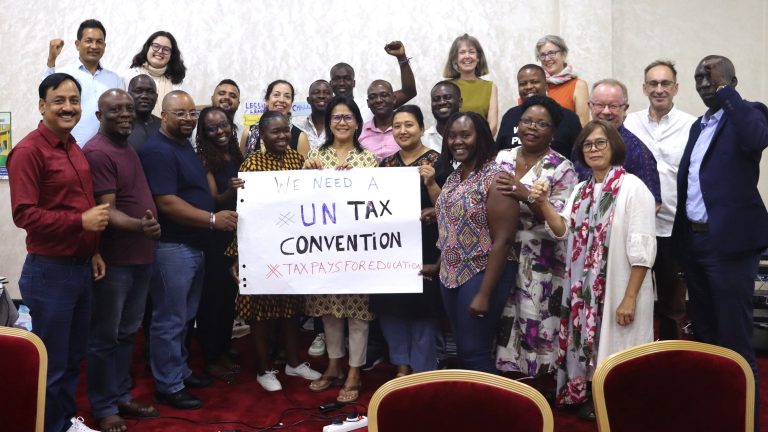
The Tax and Education (Tax Ed) Alliance brings together in partnership global tax justice, education, human rights and feminist actors to make a transformative breakthrough in the domestic financing of quality, inclusive public education.
ActionAid, Center for Economic and Social Rights, Education International, Global Alliance on Tax Justice, Global Campaign for Education and Tax Justice Network are creating a strong civil society alliance at national, regional and global levels to advocate for and bring about commitments to increase the domestic financing of public education systems in a sustainable and progressive way.
Foundational Framework For Education Financing: The 4S Framework
To achieve SDG4, countries must fulfil their obligations to provide free, quality public education. Increasing the size, share, sensitivity, and scrutiny of the budget is essential to ensure public schools have adequate resources to deliver the right to education.
The Transforming Education Financing Toolkit sets out a bolder vision for financing education. The toolkit outlines the 4Ss approach, which offers a way forward which re-centres domestic financing and can catalyse greater investment in education by resisting austerity.
The share of the budget is the percentage of the country’s total budget that is spent on education.
Size
The size of the budget is the total amount that the government has to spend. This depends on how much tax is collected and what economic policies are followed.
Scrutiny
Scrutiny of the budget helps to ensure that the money allocated for a service arrives where it is needed.
Sensitivity
Sensitivity of the budget relates to which budgets and spending address educational inequalities.
The 5Rs of Tax Justice
Our tax systems are our most powerful tools for creating just societies that give equal weight to the needs of everyone. Here’s what our tax systems can deliver if we reprogramme them to work for everybody, instead of just the wealthy few. Learn more about the 5Rs HERE.
Revenue
to fund universal public services and sustainable infrastructure.
Every second, a nurse’s yearly salary is lost to a tax haven. Over $483 billion in tax is underpaid each year by corporate giants and the super rich that could be going to our public services.
Redistribution
to curb inequality between individuals and between groups.
Women provide 71% of unpaid dementia care hours globally. Tax can fund public caregiving systems, redistributing and reducing care burdens.
Repricing
to limit public “bads” like carbon-intensive products and promote “goods”, like sustainable local production.
A lower VAT rate on public transport fares and a higher tax rate on vehicle ownership can increase use of public transportation. Higher taxes on ownership of private jets and other highly polluting transportation can discourage their use by the super rich.
Representation
to strengthen democratic processes and improve democratic governance.
Reliance of government spending on tax revenues is strongly linked to higher quality of governance and political representation.
Reparation
to redress the historical legacies of colonisation and ecological damage.
Reprogramming the global tax system to protect people’s needs and rights can help countries fund a transition to food systems that server people and planet.