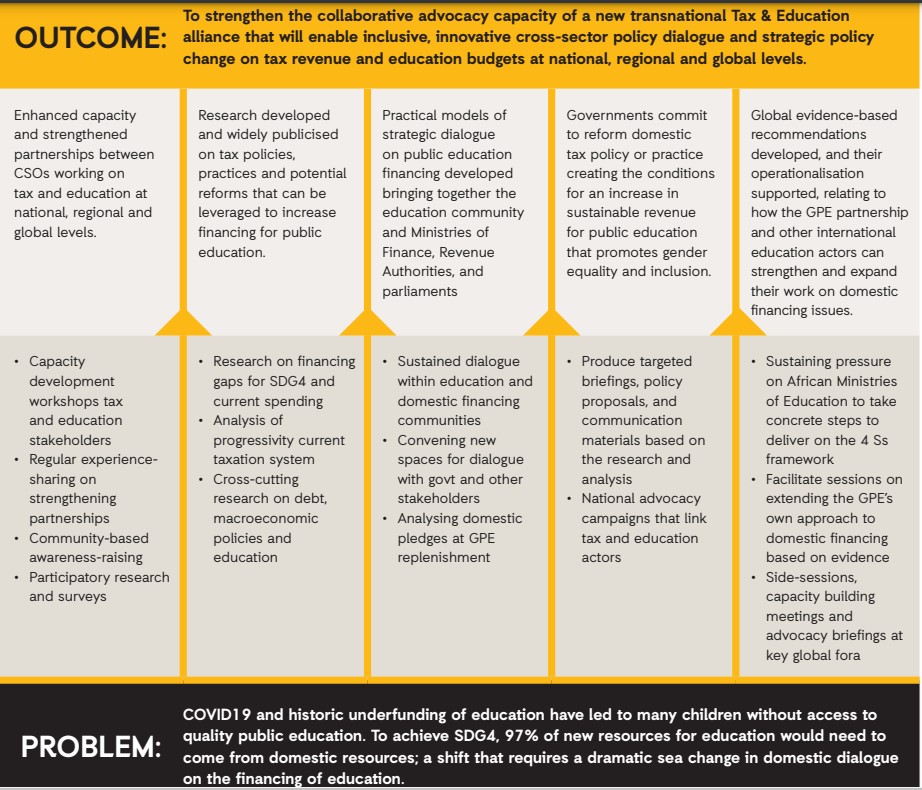
To increase sustainable, progressive, and gender-responsive financing for public education systems to enable lower income governments to realise their commitments relating to SDG4.
The Tax and Education (Tax Ed) Alliance brings together in partnership global tax justice, education, human rights and feminist actors to make a transformative breakthrough in the domestic financing of quality, inclusive public education.
ActionAid, Center for Economic and Social Rights, Education International, Global Alliance on Tax Justice, Global Campaign for Education and Tax Justice Network are creating a strong civil society alliance at national, regional and global levels to advocate for and bring about commitments to increase the domestic financing of public education systems in a sustainable and progressive way.
This is critical especially to lower income governments in order that they can achieve the Sustainable Development Goal for Education (SDG4) and the right to education for all. Lower income countries, even those that spend a significant share of their national budgets on education are unable to fulfil their SDG4 commitments, because there is insufficient revenue to fund quality, public education.
Due to the way the COVID-19 pandemic was managed, on top of years of austerity policies, education systems face a devastating crisis in public financing, and uncertainty over the quality of learning available when children return to schools. Solutions for education financing and tax reform must respond to this challenge.
The TaxEd Alliance connects CSO stakeholders working on tax issues with those working on education, human rights and gender justice to create an effective transnational CSO response. The Alliance aims to integrate the voices of marginalized communities with national level CSOs such as teacher unions and tax justice alliances, and coordinate their responses across national, sub-regional, regional and global agendas and arenas. Building on work done in Uganda, Ghana, Kenya, Malawi, Mozambique, Nigeria and Tanzania over many years, this project is deepening the national focus in Nepal, Senegal and Zambia.